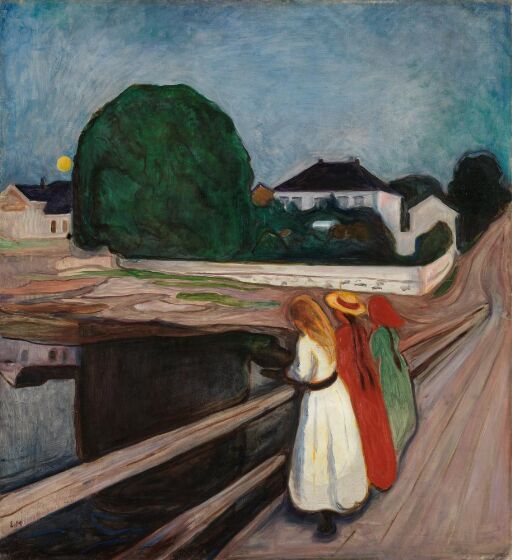
The Girls on the Bridge
- Artist: Edvard Munch
- Creation date: Antagelig 1901
- Object type: Painting
About
Edvard Munch drew inspiration from the bright Nordic summer nights. In general, nature plays an essential part in Munch’s pictures. The interplay between people and the landscape forms a symbolically coherent entity.
Three girls stand on a bridge with their backs to the viewer. They are leaning against a railing, looking down into the water. The figures, landscape and building in the background are painted in a simplified manner, giving the painting a decorative effect. The girls’ brightly coloured dresses form a contrast with the pale pink, light blue and muted dark green of the landscape.
From the bridge we are looking towards Åsgårdstrand, the coastal village by the Kristiania Fjord that inspired many of Munch’s motifs during the time he spent there. In the background we can see the stately Kiøsterudgården manor, which appears in several of his paintings, along with a large, dark-green tree. The low-hanging full moon can be glimpsed on the horizon behind the tree. The railing along the bridge and the winding road draw the viewer into the landscape. This is a compositional device that we recognise from Rue Lafayette (1891) and The Scream (1893), among other works. Taking individual elements from his own pictures and placing them in new contexts is a recurring theme in Munch’s artistic practice.
The painting has had different titles and was shown for the first time at an exhibition in Kristiania in 1901 as Sommeraften (Summer Evening). It was also included in Munch’s exhibition at the Berlin Secession in 1902, under the title Norwegische Sommernacht (Norwegian Summer Night). Its monumental format, simplified renderings and use of colour evoke associations with The Dance of Life, but the substance of the two pictures is different. The thematic basis of The Dance of Life is symbolism related to love, whereas The Girls on the Bridge shows three children and features fewer narrative and action-oriented elements.
In the following years Munch’s paintings displayed his interest in depicting childhood and the child’s view of the world. In 1898 he bought a small house in Åsgårdstrand, a place that appealed to him. The purchase gave him a closer connection to the local community, which enabled him to use some of the people there as models, as here in The Girls on the Bridge. He later commented on the village: “Walking here is like walking among my paintings. I have such a desire to paint when I am walking in Åsgårdstrand.”[1] Munch painted several versions of this motif and also a variation with young women on the bridge. The painting in the collection of the National Museum is the first of these different variations.
Literature:
- [1] Nasjonalmuseet. Høydepunkter. Kunst fra antikken til 1945 (National Museum. Highlights. Art from Antiquity to 1945), p. 166
- Hans Martin Frydenberg Flaatten, Edvard Munch. Måneskinn i Åsgårdstrand. Edvard Munchs sjelelandskap, scener, stemmer og stemninger i en småby ved sjøen (Edvard Munch: Moonlight in Åsgårdstrand. Edvard Munch’s Spiritual Landscapes, Scenes, Voices and Moods in a Village by the Sea) (Oslo: Sem og Stenersen, 2013), pp. 146–152
- Ragna Stang, Edvard Munch. Mennesket og kunstneren (Edvard Munch: The Man and His Art) (Oslo: Aschehoug, 1977), pp. 170–172
Artist/producer
Edvard Munch
Visual artist, Painter, Graphic artist, Photographer, Drawing artist
Born 12.12.1863 in Løten, Hedmark, death 23.01.1944 in Oslo
Work info
Related works
