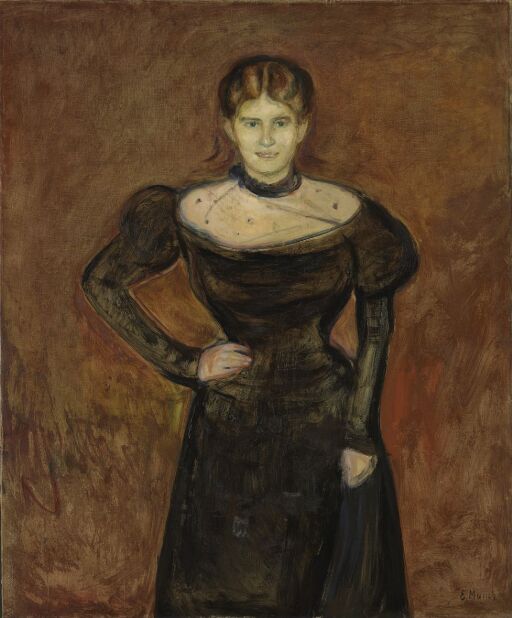
The subdued palette and frontal depiction of the figure against a crude background are typical of Munch's portraits around 1900. This is a variation on the approach he used in portraits such as Inger in Black and Violet and Ragnhild Bäckstrøm (The National Museum, NG.M.00499, NG.M.02814). As with the former, *Aase Nørregaard *is painted with thin layers of colour to create subtle effects of light and haze that contrast with the greater plasticity of the face. Nørregaard is wearing a stylish dress with puff sleeves, a wide neckline with sections of sheer fabric, typical of the bourgeois fashions of the day. Beyond this, there are few details that betray the period or the setting. Aase Nørregaard (b. Aasta Carlsen, 1869--1908) was a close friend of Munch from the late 1880s onwards. She too was a painter with a training from the Royal School of Design (Tegneskolen). In 1888, she made her debut at the National Annual Autumn Exhibition, an event she participated in several times until 1902. She later studied under both Gerhard Munthe and Harriet Backer. In her own work, Nørregaard focused in particular on modern, urban exteriors, in an idiom that reflected contemporary realism and mood painting. This can be seen, for example, in her 1898 painting Kristianiagårder (View from Kristiania) in the National Museum's collection (NG.M.00960b).
Munch painted several portraits of Nørregaard (1888-1889, Woll 2008, M 167, M 542). She also served as model for several figures in larger compositions such as Damene på bryggen (The Women on the Bridge) (1902, Woll 2008 B, M 541). Various letters and draft letters indicate that they developed a close relationship in the late 1880s. In 1889, however, she married the lawyer Harald Nørregaard. Since her married name was then identical to that of the more famous Aasta Nørregaard (1853-1933), also a painter, she changed her first name to Aase. Her friendship with Munch endured even after she married.
Nørregaard's significance for Munch is evident from a letter he wrote to her bereaved husband after Aase's death in 1908: "You know that I know what you have lost -- You think You have lost all Spring and Summer -- And there are no words of comfort -- You also know how great my own loss, the best of my women friends." (letter, 1908, emunch.no: MM N 3671).
The date of the portrait has been a subject of debate. It may have been exhibited in Paris in the spring of 1896, and it is assumed that it was painted the previous year. However, in the exhibition shown in Zurich, Bern and Basel in 1922, and later at the National Gallery in 1927, it was ascribed to 1899. The painting has similarities to the double portrait Aase and Harald Nørregaard from 1899 (The National Museum, NG.M.01794). It is reasonable to infer that these works were executed at around the same time (cf. Eggum 1994; Woll 2008 M 457, M 458).
Øystein Ustvedt
The text was first published in Edvard Munch in the National Museum. A comprehensive overview (Oslo: National Museum, 2022).