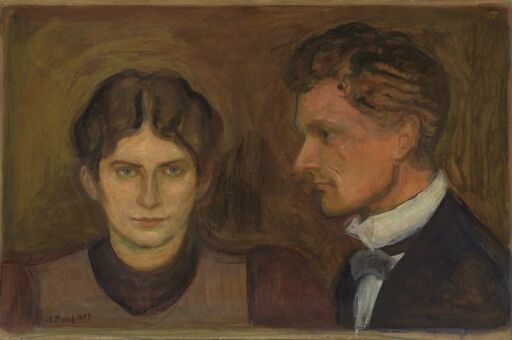
Munch produced several double portraits in the period around 1900, often of couples. In the painting of Aase and Harald Nørregaard, he highlights the relationship between the two by portraying the woman's face as active and frontal and that of the man in profile. They look beyond each other while also engaging in dialogue.
Aase (b. Aasta Carlsen, 1869--1908) and Harald Nørregaard (1864--1938) married in 1889. To avoid confusion with Aasta Nørregaard, an already well-established painter, the former changed her first name to Aase. Aase was a fellow painter who had been befriended with Munch since the 1880s. She and Harald maintained close contacts with Munch and several other artists. Over the years, they built up a significant art collection that contained several works by Munch, including this double portrait, the portrait of Aase alone, a self-portrait, and The Sick Child (The National Museum, NG.M.01793, NG.M.01915, NG.M.00839).
Harald Nørregaard studied law and became a Supreme Court lawyer. In 1894-95 he fought and won a case on Munch's behalf against the lawyer Ludvig Meyer, who wished to cancel a commission for a portrait of his children. Later, Nørregaard assisted Munch both financially and in other private matters on a number of occasions. In 1892, after several years in Stavanger, the couple moved to Kristiania, where Harald became a barrister and established a law firm.
In a letter dated 1 June 1935, Harald Nørregaard offered to donate a double portrait to the National Gallery, together with the portrait of Aase. The letter states that the gift was made at the request of Munch, who wanted both works to accrue to the National Gallery. It is mentioned that, on making the request, Munch had described the double portrait as an "anthem to [their] marriage" (National Museum's documentation archive, j.no. 3/135).
Øystein Ustvedt
The text was first published in Edvard Munch in the National Museum. A comprehensive overview (Oslo: National Museum, 2022).