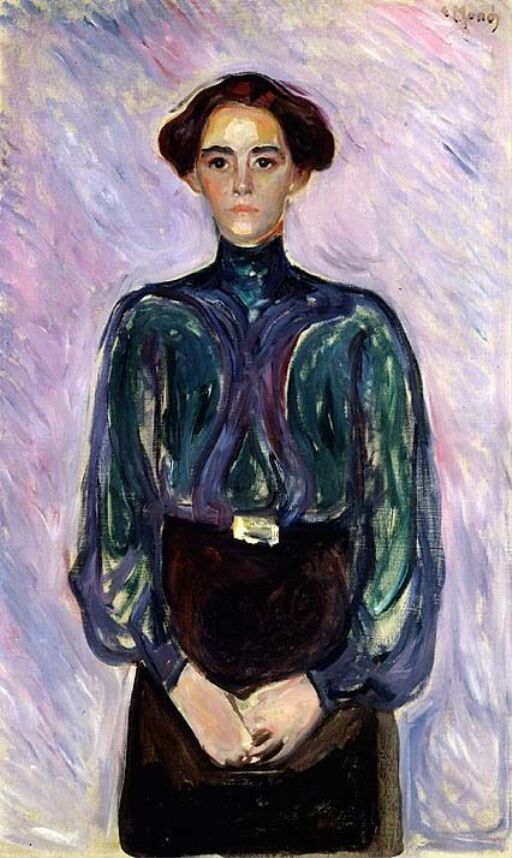
The painting was made during a period when Munch produced several portraits of wealthy patrons, collectors and connoisseurs in German cultural circles, many of them on commission. The frontal pose with the hands at rest or gathered in front of the body is characteristic of his depictions of young women; comparable works include his portraits of Inger Munch, Ragnhild Bäckström and Aase Nørregaard (The National Museum NG.M.01862, NG.M.00499, NG.M.02814, NG.M.01793). The loose painting style, on the other hand, with its broad, sweeping brushstrokes, clear colour contrasts and distinctive touches of green, is typical of his paintings around 1906. The rendering of the blouse is particularly eye-catching, and seems to influence the idiom as a whole. Both the overall form and the woman's costume are indicative of the period's defining interest in elegance.
Munch also produced a lithographic portrait of the same woman (1906, Woll 2001, G 282) and two prints of her son Andreas Schwarz (1906, Woll 2001, G 280, G 281). In addition, he depicted the woman seated in another painting from the same period (1906, Woll 2008, M 697).
The identity of Mrs Schwarz has been debated. It was once believed that she was married to the German art historian Karl Israel Schwarz (Eggum 1994), but this has since been refuted (Johannesen 1999, Lange 2004, Ustvedt 2013). In a letter addressed to the National Gallery (20 February 1992), Marlene de Man-Flechtheim claimed that the portrait was of her mother, Maria-Helene Flechtheim, née Kohlsted (1882--1971). Maria-Helene's first marriage was to Georg Schwarz (1861--1936?), with whom she had two children: Andreas, born 1906, and Nickel, born 1908. The couple divorced in 1911, and Maria-Helene later married Julius Flechtheim (1882--1978). The identification seems plausible, since Georg Schwarz was a partner in Paul Cassirer's art dealership in the period 1901--1911. Munch had close contacts with the Paul and Bruno Cassirer brothers during these years and exhibited several times at the Kunstsalon Cassirer in Berlin. The date is also confirmed in a letter from Munch, in which he writes: "Ich male Frau Schwarz" (MM N 2334). The letter is undated, but written on the headed notepaper of Hotel Beyer in Berlin, a hotel where Munch stayed frequently in the years 1905--1906.
The painting was gifted to the National Gallery as part of the Charlotte and Christian Mustad bequest that was agreed in 1959, although it was only incorporated into the collection on the latter's demise in 1970.
Øystein Ustvedt
The text was first published in Edvard Munch in the National Museum. A comprehensive overview (Oslo: National Museum, 2022).