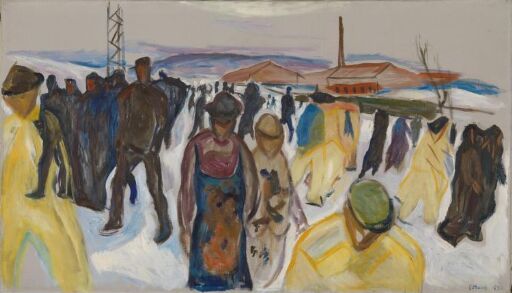
The picture probably shows a view of the Eureka Mekaniske Verksted, a
factory at Skøyen, near Munch's home at Ekely (Woll 2008, 1232).
Manual labourers became a central theme of Munch's art from around 1910.
He depicted workers from shipping, forestry, agriculture and
manufacturing industries, and even those who helped to build his studio
at Ekely. He developed plans for a monumental frieze on the theme of
manual labour for Oslo City Hall, also called the Oslo Frieze (Woll
1993, 99). Although the work was never realised, his sketches and
studies reveal his vision, and the theme is thoroughly discussed by Gerd
Woll (Woll 1993). Munch first addressed this theme in 1909, having just
moved to Kragerø after many years abroad (Woll 2008, M 873; M 874; M
876; M 877). It was an interest he pursued during the period he
lived at Jeløy near Moss, where he frequently encountered local factory
workers.
After moving to the property he had bought at Ekely in 1916, Munch found
new material for his series on labourers, including the scene depicted
here. A mass of people trudges forward towards the viewer, some in
black, others in paler clothes. In the background stands the factory
with its tall chimney stack, which is balanced in the picture by an
electrical pylon to the left. Munch has chosen to set the workers in a
snow-covered winter landscape. With rapid brushstrokes, he evokes the
dynamic of the flowing crowd, the speed and motion of the workers as
they head home at the end of their working day. With this work, Munch
created an image of modern society at the phase of industrialisation,
expansion, and growing solidarity among the working class. In his
pictures, he alternates between the themes of actual physical labour and
groups of workers on their way home at the end of their shifts. His
pictures of smaller towns or forestry work differ from the
representations of factories in modern urban centres. One of the art
historical precedents for these labourer scenes is the work of Belgian
artist Constantin Meunier (1831--1905) and his depictions of miners.
The picture was first shown at an exhibition at Blomqvist in Kristiania
in 1921. It also featured in the major 1927 retrospective in Berlin and
Oslo. In addition, Munch painted a large watercolour of the same scene
(The Munch Museum, MM.T.01855), and in connection with the commission for Freia Chocolate
Factory, it served as the basis for a small preparatory sketch in
coloured pencil (The Munch Museum, MM.T.02025; Woll 2008, 1232). The painting entered the
museum's collection in 1970 as part of the Charlotte and Christian
Mustad bequest.
Wenche Volle
The text was first published in Edvard Munch in the National Museum. A comprehensive overview (Oslo: National Museum, 2022).