About
A young woman stands washing herself. The room is simple and austere. There is no indication of opulence or a luxurious way of life. Half turned away, the girl’s naked back and slender figure is illuminated by light from the window in the background. The window seems to echo the picture’s upright format, marking a separation from the world outside. Is it sunlight or moonlight that we see, morning or evening, day or night?
The scene is intimate and revealing. We are witness to a private moment in which the woman is also vulnerable. Such intimate interior scenes were popular in the late 19th century, especially in Paris, where artists such as Edgar Degas, Henri de Toulouse-Lautrec and Pierre Bonnard worked with this kind of motif. Munch painted the picture during a stay in Paris in 1896. For several years he had been depicting women in various large format, broodingly symbolic works linked to his “Frieze of Life” (including Madonna, The Kiss, Vampire and Dance of Life). In this work the woman is depicted in a more prosaic and mundane context. It is one of the first in a series of related nude studies that shows a different aspect of Munch’s creative activity.
The paint is applied in thin, semi-transparent layers, creating an almost translucent quality. The texture of the wood panel on which the work is painted can be seen in many parts of the picture. Together with the subtle use of colour, this creates a poetic dimension, while simultaneously emphasising the work’s inherent pictorial quality.
This painting was donated to the National Gallery by Olaf Schou in 1909.
- Edvard Munch bestandskatalog
In the years around 1896, Munch painted several female nudes and studies of models, including this one. Here he may have used the same model as in another painting in the National Museum's collection, Parisian Model (The National Museum, NG.M.02816). Young Woman Washing is somewhat different from the other works in this group in terms of the emphasis placed on the interior and other details of the location. The window and the sink with running water suggest a modern urban setting around the turn of the last century.
Light from the window illuminates the room and the female figure, who stands with her back half turned to the viewer. The palette is restrained, with dominant hues of cool grey-green blue and warm skin tones with hints of red. The work is striking in terms of technical execution. The colours are applied in thin, diluted washes that contrast with isolated pastose strokes. The texture and grain of the underlying wood shimmer through the layers of paint in a way that gives unity and coherence. Munch's use of the panel's inherent structure to enhance the idiom echoes his handling of the wood matrix in his woodcuts, a medium he began to explore in the year he painted this picture.
In the latter half of the 19th century, indoor scenes depicting women in the process of dressing or undressing, washing or bathing, naked or semi-naked, were very popular. Sometimes they carry erotic overtones. This was especially true among the trendsetting artists of Paris, such as Edgar Degas, Henri de Toulouse-Lautrec and Pierre Bonnard, who forged a genre from such situations.
The painting was probably done during Munch's 1896 stay in Paris. It is not marked with a date, but was ascribed to the year 1896 at the major exhibitions in Berlin and Oslo in 1927. The work is painted on a wooden panel consisting of five sections, made from poplar and birch. The painting was part of Olaf Schou's sizeable donation to the National Gallery in 1909. It has been little discussed in the literature.
Øystein Ustvedt
The text was first published in Edvard Munch in the National Museum. A comprehensive overview (Oslo: National Museum, 2022).
- Creation date:
- (1896)
- Other titles:
- Ung kvinne som vasker seg (NOR)
- Object type:
- Painting
- Materials and techniques:
- Olje på treplate
- Dimensions:
- Width: 59 cm
- Height: 74.5 cm
- Keywords:
- Visual art
- Classification:
- 532 - Bildende kunst
- Motif - type:
- Portrait, Figure study
- Inventory no.:
- NG.M.00843
- Cataloguing level:
- Single object
- Acquisition:
- Gift from Olaf Schou 1909
- Provenance:
- [40] Previous owner, Olaf Schou
- Owner and collection:
- Nasjonalmuseet for kunst, arkitektur og design, The Fine Art Collections
- Photo:
- Høstland, Børre
- Hansen, Vibeke Waallann, et al. Edvard Munch i Nasjonalmuseet: en samlet oversikt. Redigert av Ustvedt, Øystein, et al. Oslo: Nasjonalmuseet, 2022. kat.nr. 33.
- Woll, Gerd. Edvard Munch: Samlede malerier: B. 1: 1880-1897. Oslo: Cappelen Damm, 2008. kat.nr. 387.
- Nasjonalgalleriet, red. Norske malerier. Katalog. Oslo, 1992. 341.
- Skedsmo, Tone. «Nasjonalgalleriets Munch-samling. En historikk», i «Edvard Munch i Nasjonalgalleriet», 1989. 10.
- Nasjonalgalleriet, red. Katalog over norsk malerkunst: med 158 illustrasjoner. Oslo, 1968. kat.nr. 1285.
- Langaard, Ingrid Lindbäck. Edvard Munch. Modningsår. En studie i tidlig ekspresjonisme og symbolisme. Oslo: Gyldendal, 1960. 392.
- Nasjonalgalleriet, red. Katalog over norsk malerkunst. Oslo, 1950. kat.nr. 1068.
- Nasjonalgalleriet, red. Norsk malerkunst i Nasjonalgalleriet. Oslo, 1933. kat.nr. 954.
- Nasjonalgalleriet, red. Edvard Munch. Utstillingskatalog. Oslo, 1927. kat.nr. 102.
Nasjonalmuseet's collection catalogue is a living resource of information gathered since the 1830's. Some records may contain language or ideas that today could be perceived as outdated, offensive or discriminatory with regard to for instance gender, sexuality, ethnicity or disability, and that may be at odds with the museum's values regarding equality and diversity.
Do you have suggestions for how this record can be improved? We would like to hear from you!
If you would like more information about specific objects in the collection or about objects that haven't been published online, please contact the museum. You can read more about how we work with the collection and our cataloguing practice here.
Other works by Edvard Munch
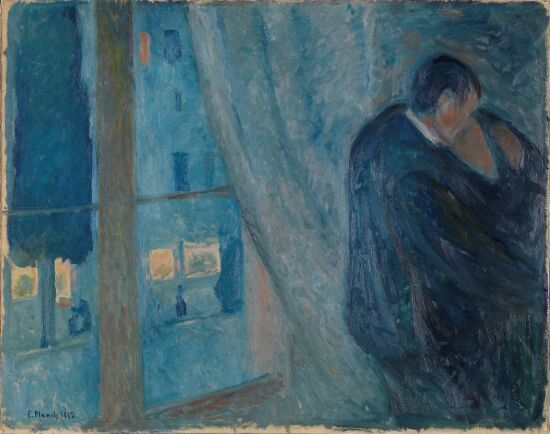 The KissEdvard Munch1892
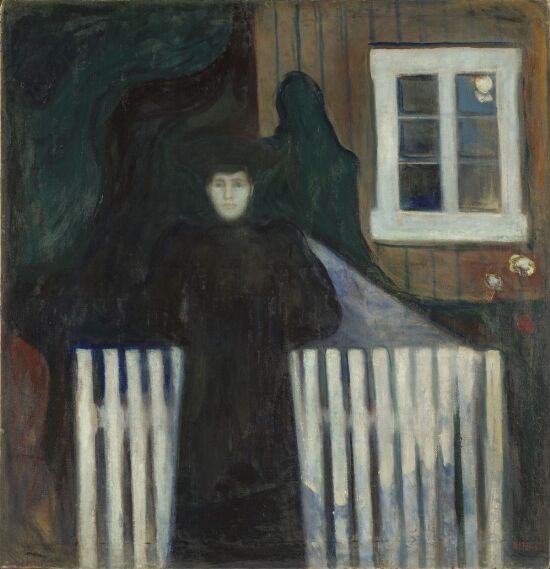 MoonlightEdvard Munch(1893)
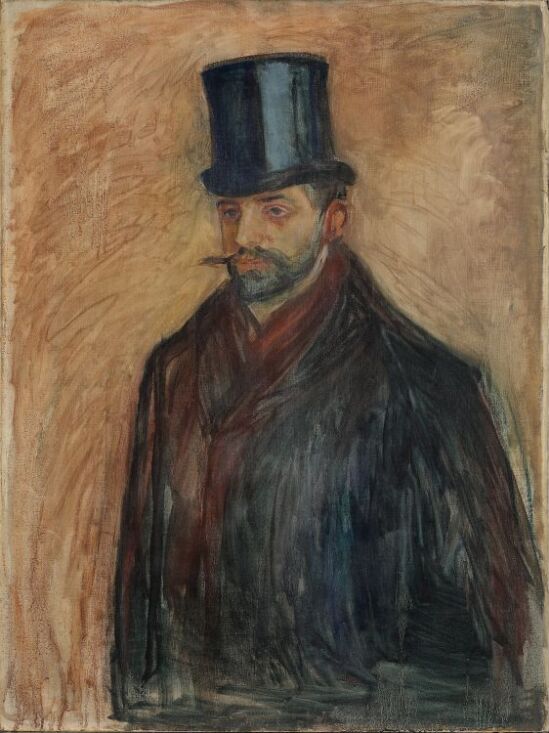 Julius Meier-GraefeEdvard MunchAntagelig 1894
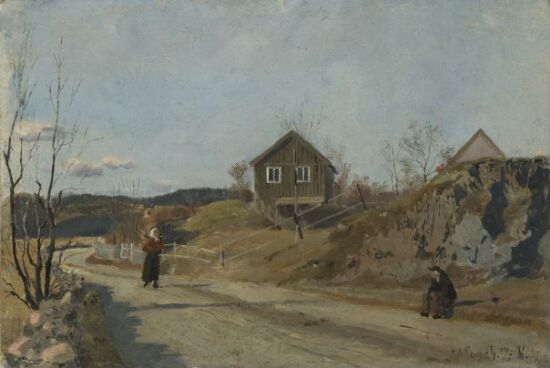 From Vestre AkerEdvard Munch1881
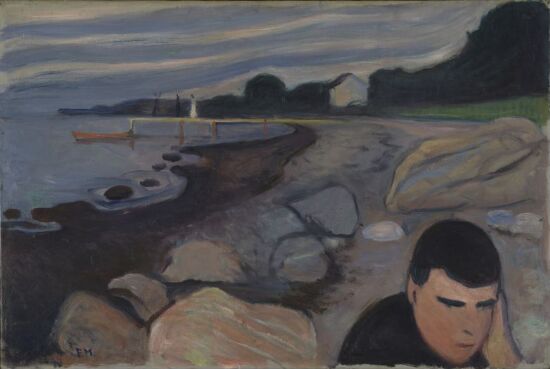 MelancholyEdvard MunchAntagelig 1892
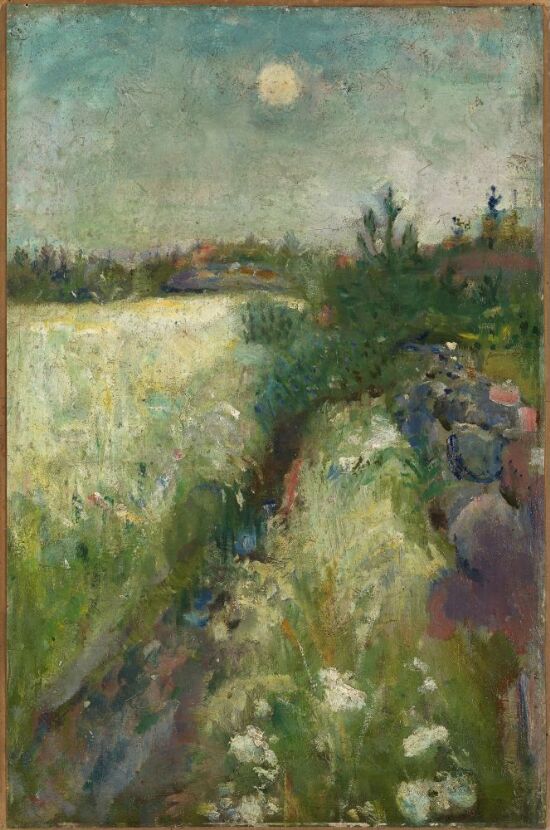 Flowery Meadow at VeierlandEdvard Munch(1887)
 White NightEdvard MunchPåbegynt 1900, avsluttet 1901
 Rue LafayetteEdvard Munch1891
 Naked Woman in Front of a HouseEdvard Munch1883 eller 1884
 Self-PortraitEdvard Munch1905
 Hjørdis GierløffEdvard MunchPlaten utført 1913 eller 1914; trykket 1914
 NudeEdvard MunchPlaten utført 1897; trykket 1913