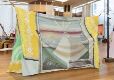
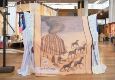
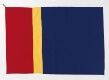
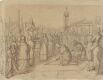
Astrid Løvaas and Kirsten Wagle forged a partnership already while attending the Norwegian Academy of Craft and Art Industry together in 1978–82, and they quickly established themselves as artists under the moniker Løvaas & Wagle. All of their subsequent works of art emanate from a collaboration where both artists are involved in all phases, from original conception to finished object. Their output is diverse, but textile provides a common frame of reference.
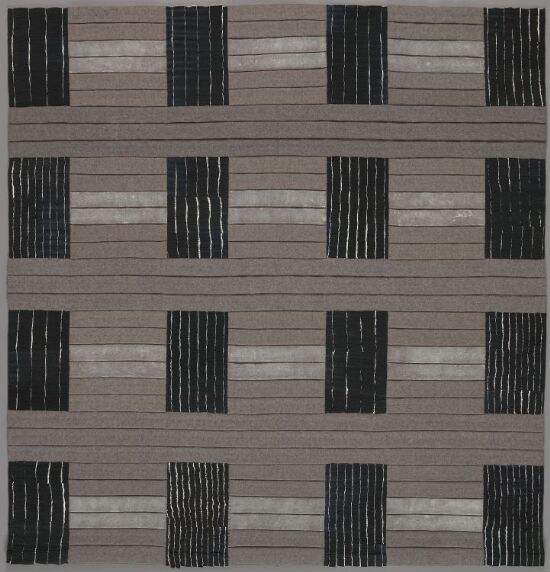
In Woven, a square flat-tapestry pattern was used to create a trellis of nylon stockings, with the selected materials, technique, and title all relating the work to the history of textile. The work preserves the reference to the geometric “nature” of woven fabric and square patterns, but the artists’ use of freehand and detachment from the loom helps contrast the fixed principle of construction with the work’s liberated composition. The nylon stockings run somewhat freely, evoking both loose threads and organic, expressive brushstrokes. At the same time, the stockings refer to the grid of abstract painting and to the characteristic intertwining of vertical and horizontal threads in woven materials.
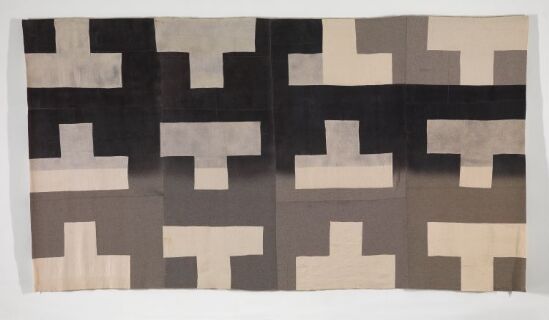
By using such discarded objets trouvés as nylon stockings, wool blankets, and socks, the duo follow an artistic tradition, epitomized in the postwar era by the Italian arte povera artists, that seeks to revitalize objects that have gone out of use. In so doing, Løvaas & Wagle take discarded textiles without practical usefulness and transform them into meaningful works of art.